REDESIGNING ISLAMIC TRANSFORMATIONAL LEADERSHIP FOR MUSLIM MINORITIES IN THE WEST
- Authors
-
-
FatimatuzzahroUIN Kiai Haji Achmad Siddiq Jember
-
Risanda A. BudiantoroUniversitas Negeri Semarang
-
- Keywords
- Islamic Leadership, Transformational Leadership, Muslim Minorities, Ethical Leadership Principles
- Abstract
Islam is a comprehensive religion that does not discuss one aspect of knowledge but covers all aspects, including leadership. Islamic leadership must be based on the pillars of Islam, namely the Qur'an and Hadith. Islamic leaders must work towards a vision to create a just society where the rule of law is upheld among all believers and non-believers. In the context of Islam in Western countries, leadership faced many challenges during the early years of the 21st century. These challenges can come from internal organizational challenges, such as social, cultural, and structural challenges. However, challenges arise from external contexts, such as social, cultural, legal, and political. In Islamic economic philosophy, the leadership model that is considered ideal is one based on fair and ethical leadership principles. This qualitative research aims to explain and redesign the transformational leadership theory with Islamic leadership. The study results are four characteristics that can influence transformational Islamic leadership: government pressure, media hostility, international politics, and a legal system. The impact of international politics unites the Muslim population to some extent. Australia's Muslim population hails from many countries, including a significant group born and raised in Australia. As a result, the Muslim population in Australia is a minority in an international context.
- References
-
Ali, A.J. "Islamic Perspectives on Leadership: A Model." Interna-tional Journal of Islamic and Middle Eastern Finance and Management 2, no. 2 (2009): 160-180. DOI: 10.1108/17538390910965167. DOI: https://doi.org/10.1108/17538390910965167
Al-Hilali, Mohamed. “Transformational Leadership and Organiza-tional Effectiveness: A Predictive Study at American Muslim Organizations.” Ph.D, Dissertation, University of Phoenix, 2012.
Anggareni, Trisna Ayu, and Leonard Adrie Manafe. “Karakteristik Kepemimpinan Situasional terhadap Kinerja Karyawan Old Town White Coffee.” Jurnal Aktual 19, no. 1 (2021): 1-9. DOI: 10.47232/aktual.v19i1.70. DOI: https://doi.org/10.47232/aktual.v19i1.70
Bass, B.M. “From Transactional to Transformational Leadership: Learning to Share the Vision.” Organizational Dynamics 18, no. 3 (1990): 19– 31. DOI: 10.1016/0090-2616(90) 90061-S. DOI: https://doi.org/10.1016/0090-2616(90)90061-S
Beekun, R.I., and J. Badawi. Leadership: An Islamic Perspective. Beltsville, MD: Amana Publications, 1999.
Beekun, R.I. Strategic Planning and Implementation for Islamic Or-ganizations. Herndon, VA: International Institute of Islamic Thought, 2006.
Burns, J. M. Leadership. New York: Harper & Row, 1978.
Dewi M.K., and H. Tanjung. “Discipline without Punishment – Is it Possible?” Proceeding of International Conference on Management from Islamic Perspective, at Hilton Kuala Lum-pur, May 15-16, 2007.
Faridi, F.R. “Islamic Research Methodology, Some Reflections.” In Research Methodology in Islamic Perspective. Edited by Mo-hammad Muqim. New Delhi: Genuine Publications & Media 1994.
Faris, Nezar, and Ken Parry. “Islamic Organizational Leadership within a Western Society: The Problematic Role of External Context.” The Leadership Quarterly 22, Issue 1 (February 2011): 132-151. DOI: 10.1016/j.leaqua.2010.12.012. DOI: https://doi.org/10.1016/j.leaqua.2010.12.012
Fatimatuzzahro, and Risanda A. Budiantoro. Interview by Anthony Andrew. Jan 12, 2023.
Hossain, M. “Case studies of Muslim Managed Organizations in Bangladesh.” Paper presented at International Conference, Management from Islamic Perspective at Hilton Kuala Lum-pur, May 15-16 2007.
James, C.S., and C.S. Joseph. “The Trans-
formational-Transactional Leadership Model in Practice.” Leadership & Organization Development Journal 22, no. 8 (2001): 383-394. DOI: 10.1108/ 01437730110410107. DOI: https://doi.org/10.1108/01437730110410107
K. Davis, Miles, and John Winn, “Islamic Leadership Models: Les-sons from Early Islam,” in Entrepreneurship and Manage-ment in an Islamic Context. Edited by Léo-Paul Dana, Shqipe Gërguri Rashiti, Veland Ramadani, Vanessa Ratten. Cham, Switzerland: Springer, 2017. DOI: 10.1007/978-3-319-39679-8_3. DOI: https://doi.org/10.1007/978-3-319-39679-8_3
Kazmi, A. “Managing from Islamic Perspectives: Some Preliminary Findings from Malaysian Muslim-Managed Organizations.” Paper presented at International Conference, Management from Islamic Perspective at Hilton Kuala Lumpur, May 15-16, 2007.
Khaliq, A. “Management Modelling from Islamic Perspectives: Some Reflections.” Ulum Islamiyyah: Malaysian Journal of Islamic Sciences 2, no. 1 (2003): 43-60. https://myjurnal.mohe.gov.my/public/article-view.php?id=84371.
_____. “Leadership and Work Motivation from the Cross-Cultural Perspective.” International Journal of Commerce & Man-agement 29, no. 1 (2009): 72-84, DOI: 10.1108/ 10569210910939681. DOI: https://doi.org/10.1108/10569210910939681
_____. “Leadership and Work Motivation from Islamic Perspec-tive.” Issues in Islamic Management: Theories and Practices. Edited by Khaliq Ahmad, Rafiqul Islam, and Yusof Ismail. Kuala Lumpur: IIUM Press, 2011.
_____. Management from Islamic Perspectives: Principles and Prac-tices, 2nd Edition. Kuala Lumpur: Pearson Malaysia, 2011.
Manzoor, Seema. “The Model of Visionary and Innovative Islamic Leadership.” Society 11, no. 1 (2023): 41-51. DOI: 10.33019/society.v11i1.539. DOI: https://doi.org/10.33019/society.v11i1.539
Mir, Ali Mohammad. “Leadership in Islam.” Journal of Leadership Studies 4, no. 3 (2010): 69–72. DOI: 10.1002/jls.20180. DOI: https://doi.org/10.1002/jls.20180
Mohtsham, Saeed M. “Vision and Visionary Leadership: An Islam-ic Perspective.” International Review of Business Research Papers 3, no. 2 (2007): 248–277. https://api.semanticscholar.org/CorpusID:155950638.
Muenjohn, Nuttawuth. "Leadership Theories and Concepts: Its Past and Present." Proceeding on Globalization, Innovation and Leadership. Hong Kong: Academy of International Business, South East Regional Conference, 2008.
Muhammad Olifiansyah, Wahyu Hidayat, Bimansyah Putra Diay-ing, and Muhammad Dzulfiqar, “Kepemimpinan dalam Per-spektif Islam.” At-Tajdid: Jurnal Pendidikan dan Pemikiran Islam 4, no. 1 (2020): 102-112. DOI: 10.24127/att.v4i01.1205. DOI: https://doi.org/10.24127/att.v4i01.1205
Osborn, Richard N., James G. Hunt, and Lawrence R. Jauch. “To-ward a Contextual Theory of Leadership.” The Leadership Quarterly 13, no. 6 (2002): 797−837. DOI: 10.1016/S1048-9843(02)00154-6. DOI: https://doi.org/10.1016/S1048-9843(02)00154-6
Parry, K.W. “Enhancing Adaptability: Leadership Strategies to Ac-commodate Change in Local Government Settings.” Journal of Organizational Change Management 12, no. 2 (April 1999): 134−156. DOI: 10.1108/09534819910263677 DOI: https://doi.org/10.1108/09534819910263677
Priharti, Dimas Veronica, and Mona Laveza Audia. “Analysis of Leadership Style and Teamwork and their
Influence on Employee Performance at Pengaringan Health Center, Semidang Aji District, Oku Regency.” Jurnal Manajemen dan Perbankan 8, no. 3 (2021): 16-31. https://journals.stie-yai.ac.id/index.php/JUMPA/article/download/401/338. DOI: https://doi.org/10.55963/jumpavol4no1feb2017.v8i3.401
Purba, Kuras, and Kusman Sudibjo. “The
Effects Analysis of Transformational Leadership, Work Mo-tivation and Compensation on Employee Performance in PT. Sago Nauli.” Budapest International Research and Critics Institute-Journal (BIRCI-Journal) 3, no. 3 (2020): 1606-1617. https://www.bircu-journal.com/index.php/birci/article/view/1091. DOI: https://doi.org/10.33258/birci.v3i3.1091
Rashid, A. “Educating for Skilled Leadership.” Paper presented at the Association of Muslim Social Scientists (AMSS) 29th An-nual Conference, Georgetown University, October 13-15, 2000.
Rosyad, Ali Miftakhu. “Internalization of Character Education Based on Islamic Values to Students at SMK Muhammadi-yah Juntinyuat.” IWOS: Islam in World Perspectives Sympo-sium 1, no. 1 (2020): 273-285. http://seminar.uad.ac.id/index.php/iwos.
Safi, Louay. “Leadership and Subordination: An Islamic Perspec-tive.” American Journal of Islamic Social Sciences 12, no. 2 (1995): 204−223. DOI: 10.35632/ajis.v12i2.2388. DOI: https://doi.org/10.35632/ajis.v12i2.2387
Ushama, Thameem, Mohamed Fouz Mohamed Zacky, Mohamed Rishad Najmudeen, Mohamed Ashath, and Sulaiman Lebbe Mohamed Hassan. “Muslim Religious Leadership Education in the Minority Context: The Role of Naleemiah Institute of Islamic Studies.” Hamdard Islamicus 47, no. 2 (2023): 29-46. DOI: 10.57144/hi.v46i2.697. DOI: https://doi.org/10.57144/hi.v46i2.697
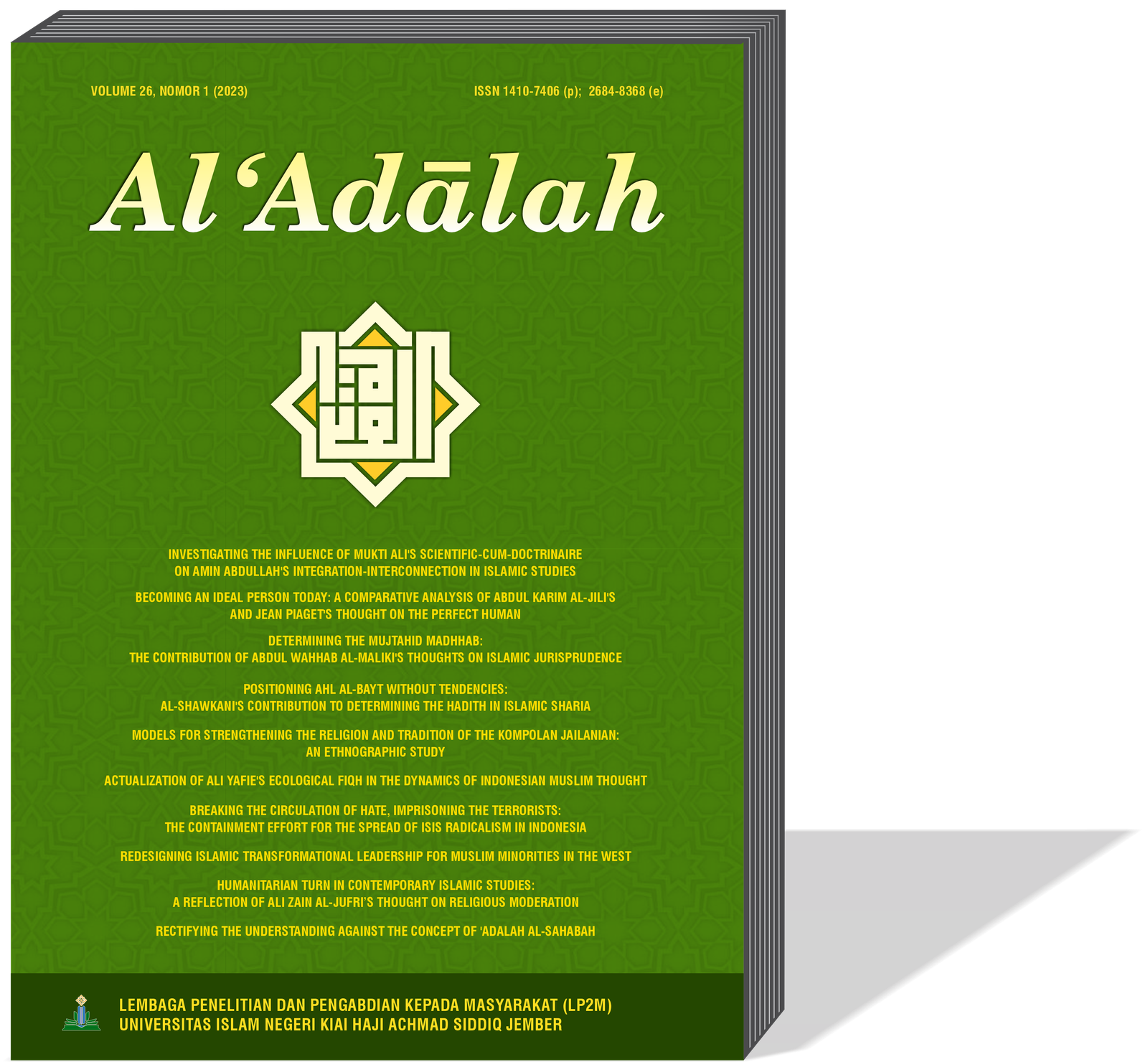
- Cover Image
-
- Downloads
- Published
- 2023-08-31
- Issue
- Vol. 26 No. 1 (2023)
- Section
- Articles
- License
-
Copyright (c) 2023 Fatimatuzzahro, Risanda A. Budiantoro

This work is licensed under a Creative Commons Attribution-NonCommercial 4.0 International License.
