PROYEK IDENTITAS KULTUR KERUKUNAN
STUDI HARMONI KEHIDUPAN WARGA NU, MUHAMMADIYAH DAN LDII
- Authors
-
-
Mohammad IsfironiUIN Sunan Ampel Surabaya
-
- Keywords
- Nahdlatul Ulama, Muhammadiyah, Lembaga Dakwah Islam Indonesia (LDII), Harmony
- Abstract
The issue raised in this paper is about the fenomena of harmony both NU, MD and LDII communities di Awar-Awar Village Asembagus Situbondo Regency. By used ethnography approach founded that harmony constructed in a social manner by NU, MD and LDII communities and elites of Awarawar village in every day life. Social construction con-sists of three moments that is externalization of religious understanding social institution, objectivation through interaction both people by social institution, and internalization is self identification by socialization. In a social manner, because of it pathernalistic character made elites construction influence to people construction. In a social manner, “pendalungan” (Hybrid culture between Java and Madura ethnic) characteristic also give cultural frame to creating harmony. The harmony condition influence all live aspects of people either in a social manner or economy and culture.
- Author Biography
-
Mohammad Isfironi, UIN Sunan Ampel Surabaya
Dosen Fakultas Syari’ah dan Hukum UIN Sunan Ampel Surabaya
DPK IAI Ibrahimy Situbondo - References
-
Abdullah, Irwan. Konstruksi dan Reproduksi Kebudayaan (Yogyakarta: Pustaka Pelajar, 2007).
Assyaukani, Luthfi. “Fatwa and Violence in Indonesia”. Journal of Religion and Society (Volume 11. 1999).
Berger, Peter, L and Luckman, T, The Social Construction of Reality (Garden City: Doubleday, 1966).
Berger, Peter, L. The Sacred Canopy: Elements of a Sociological Theory of Religion (New York. Anchor, 1967).
_________. Revolusi Kapitalis. ter. Mohamad Oemar (Jakarta: LP3ES, 1990).
Castell, Manuel. The Power of Identity (Malden: Blackwell Publishing, 2004).
Cassirer, Ernst. Manusia dan Kebudayaan: Sebuah Esei Tentang Manusia. ter. Alois A. Nugroho (Jakarta: Gramedia, 1987).
Featherstone, Mike. Global Culture: Nationalism, Globalization and Modernity (London: SAGE Publications, 1990).
_________. Consumer Culture and Postmodernism (London: SAGE Publications, 1991). Geertz, Clifford. Interpretation of Cultures: Selected Essays (New York: Basic Books, 1973).
Guba E.G. & Lincoln, Y.S. & Naturalistic Inquiry (Beverly Hill: SAGE Publication Inc, 1985).
Isfironi, Mohammad. “Pemikiran Keagamaan Kiai di Situbondo: Studi Pendekatan Fiqh dalam Merespon Masalah Sosial Keagamaan”. Tesis (Malang: UNISMA Malang, Program Pascasarjana, 2002).
_________. Agama dan Solidaritas Sosial: Studi terhadap Tradisi Rasulan Masyarakat Gunung Kidul DIY. Laporan Penelitian (Yogyakarta: 2009).
Lincoln, Y.S. dan Denzin, N.K.. “The Seventh Moment: Out of the Past” dalam N.K. Denzin & Y.S Lincoln (ed). Handbook of Qualitative Research (London: SAGE Publications, 2000).
Marshall, Catherine and Rossman, B, Gretchen. Designing Qualitative Research. (California: SAGE Publications, 1990).
Mas’ud, Abd. Rahman. “Nahdlatul Ulama and Muhammadiyah, Two of Indonesia’s Muslim Giants: Tension Within Intimacy (Harmony)”, Jurnal Multikultural & Multireligius HARMONI (No. 34. Vol. IX, 2010).
Mulder, Niels. Kebatinan dan Hidup Sehari-hari orang Jawa (Jakarta: Gramedia, 1984).
Mulyana, S. Negarakretagama dan Tafsir Sejarahnya (Jakarta: Bhratara Karya Aksara, 1979).
Nasikun. Sistem Sosial Indonesia (Jakarta: Rajawali Pers, 2007).
Nawiyanto. ”Pertumbuhan Penduduk Besuki: Kajian Demografi Historis”. HUMANIORA (Vol. 21 No. 2 Juni, 2009).
Newman, Lawrence, W. Social Research Methods: Qualitative and Quatitatives Approaches. 4 th. Ed. (Sydney: Allyn and Bacon, 2000).
Nordholt, Schulte, Henk dan Klinken, van, Gerry. Politik Lokal di Indonesia. (Jakarta: Obor, 2007).
Rahmawan, Jamhari, Ahmad dkk., “Faktor Kerukunan Antar Umat Beragama Di Desa Balun Kecamatan Turi Kabupaten Lamongan Sebagai Solusi Konflik Antar Umat Beragama Di Indonesia” Laporan Penelitian (Bogor: Fakultas Kehutanan, Institut Pertanian Bogor, 2008).
Ritzer, George and Goodman J. Douglas. Teori Sosiologi. Ter. Inyak Ridwan Muzir (Yogyakarta: Kreasi Wacana, 2009).
Spradley, P, James, Metode Etnografi, ter. Misbah Zulfa Elizabeth (Yogyakarta: Tiara Wacana, 2006).
Suseno, SJ., Magnis, Franz. Religious Harmony in Religious Diversity. The Case of Indonesia. Dalam Wasim, Theria, Alef et.al (ed.) Religious Harmony: Problems, Practice and Education. Proceeding of the Regional Conference of the International Association for the History of Religions (Yogyakarta dan Semarang Indonesia: September 27th 2004, 2005).
Sutarto, Ayu. 2006. ”Sekilas tentang Masyarakat Pendalungan” Makalah Pembekalan Jelajah Budaya 2006”, diselenggarakan Balai Kajian Sejarah dan Nilai Tradisional Yogyakarta tanggal 7-10 Agustus 2006.
Syam, Nur. Islam Pesisir (Yogyakarta: LkiS, 2005).
Anam, Choirul. Dkk. Fakta dan Kesaksian Tragedi Situbondo (Jatim: Tim Pencari Fakta GP Anshor Jatim, 1996).
Wasim, Theria, Alef et.all (ed.) Religious Harmony: Problems, Practice and Education. Proceeding of the Regional Conference of the International Association for the History of Religions. Yogyakarta and Semarang Indonesia. September 27th 2004, 2005).
Weber, Max. Economy and Society: An Outline of Interpretive Sociology (Berkeley, Los Angeles, London: Universityof California Press, 1978).
http://www.yadmi.or.id/index.php?option=com_content&view=article&catid=38%3Aterkini&id=549%3Aatho-mudzhar-sikap-toleran-menjadi-kontribusi-terciptanya-kerukunan&Itemid=69 diunduh pada Kamis, 24 Juni 2010.
http://ldii.info/sejarah-ldii.html diunduh pada Kamis, 24 Juni 2010.
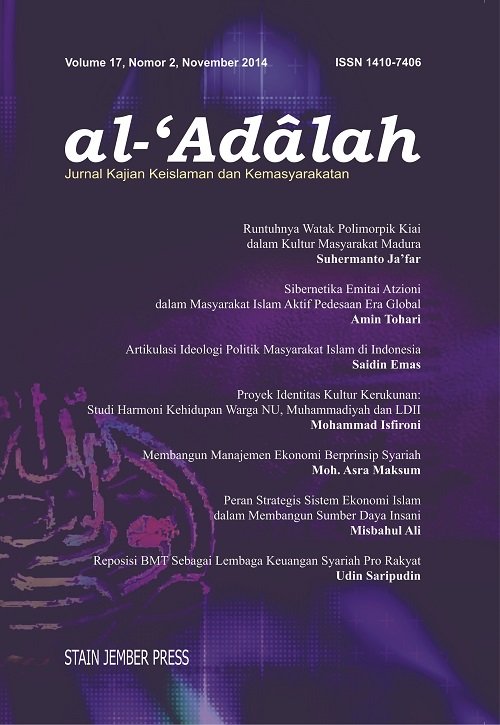
- Cover Image
-
- Downloads
- Published
- 2022-03-17
- Issue
- Vol. 17 No. 2 (2014)
- Section
- Articles
- License
-

This work is licensed under a Creative Commons Attribution-NonCommercial 4.0 International License.
